


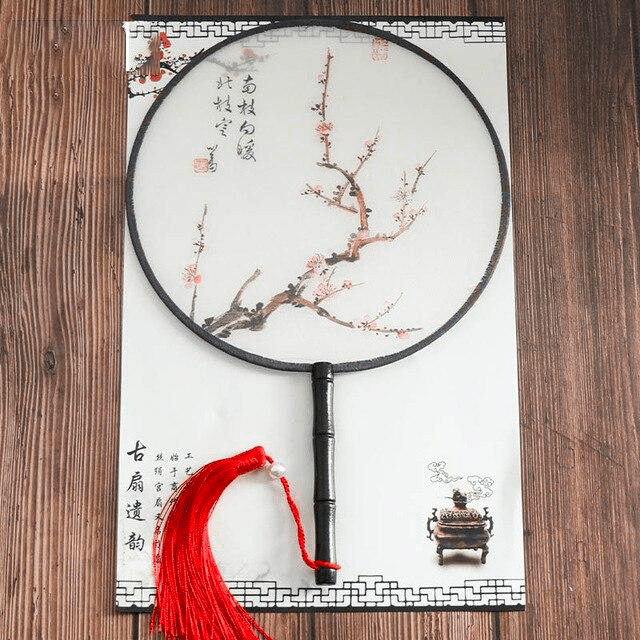


Discover our collection of Chinese Fans
Providing you with the best Chinese fans is our priority. That's why all our fans are authentic Chinese fans, created according to the Chinese tradition and know-how. We are committed to offering quality Chinese fans.
Moreover, we commit ourselves to regularly renew our catalog of Chinese fans, to always quench your thirst of discovery of China. Finally, we commit ourselves to answer all your requests and questions in 48 hours maximum.
History
Chinese fans have a history of over 3000 years. They were invented during the Shang Dynasty (1570 - 1045 BC). The first type of Chinese fan was called Shanhan, it was then hung above the carriages to bring some shade and protect the passengers from the rain. The Shanhan fan was therefore far from the function we know today! It was in fact closer to an umbrella or a parasol, depending on the weather.
Later, the Shanhan evolved and received a long handle, and was made of bird feathers or silk. It was then called Zhangshan fan, and it was mainly used by the Emperor's honor guard or as a decoration. So it was not used for refreshment purposes until the Zhou Dynasty, more than 2000 years ago. At that time, it was still mainly made of feathers and was used by the nobility.
It was popularized to all Chinese social classes during the Hans Dynasty (206 BC - 220 AD). At that time, it was mainly made of bamboo and reed leaves, which were much cheaper than feathers, and therefore accessible to all social classes. During the Song Dynasty (420 - 479), the moon fan, with its half-moon shape, was invented and became very popular among young women, especially those of the imperial court.
It then evolved to take on different shapes, notably round and oval. The rims of the fan were made of small animal bones or bamboo, and the handle was decorated with lucky engravings, and sometimes with stones such as jade. Fans were already beautiful representations of traditional Chinese art, and the silk screen was often decorated with landscapes, flowers or mythological scenes.
Fan paintings were so popular that they greatly contributed to the development of Chinese art itself, and became a style of artistic expression in their own right. Today, the most common fans are no longer round fans, but rather folding fans, which were introduced to China by the Japanese during the Song Dynasty. Legend has it that the Japanese created it after being inspired by bat wings. Since the folding fan was much more practical and could be easily carried everywhere, it soon became a real fashion item in China.
They were then real handicrafts, whose rims were made of noble materials, such as tortoise shells, ox horns, ebony, marbled bamboo, ivory elephant tusks, or jade. Nowadays, there are more than 500 different types of Chinese fans, among which the most famous are the sandalwood fans from Suzhou, Jiangsu province, or the silk fans from Hangzhou, Zhjiang province.